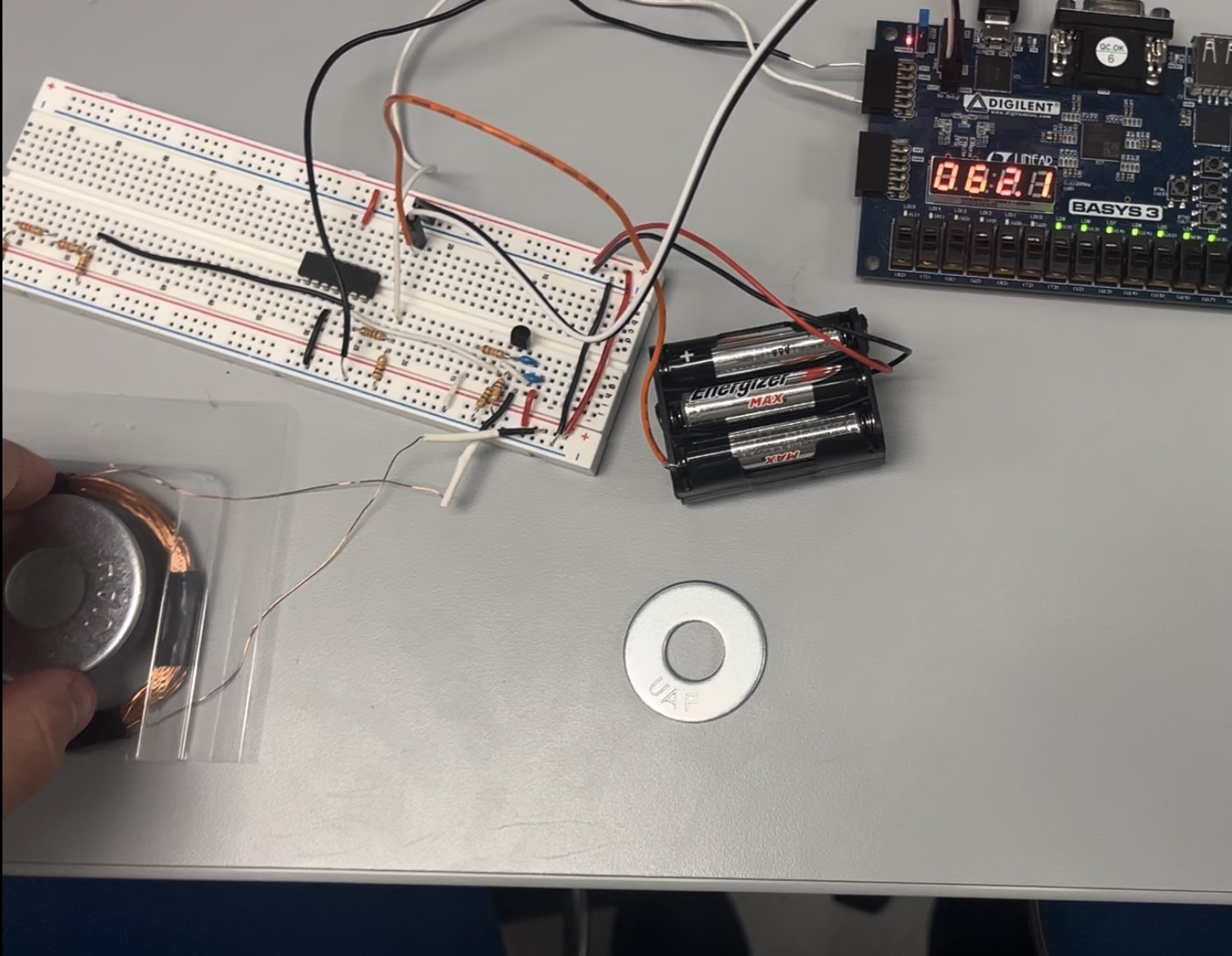
As part of a multidisciplinary team of two other computer engineers and one electrical engineer, I contributed to the development of a battery-powered FPGA system designed to detect and measure magnetic field strength. The system utilized a softcore processor to process sensor data and display real-time readings on a 7-segment display. My role focused on programming the FPGA, developing embedded C code for efficient signal processing, and ensuring seamless integration of the hardware and software components.
The electrical engineer on our team designed and implemented a Colpitts oscillator to generate an AC signal, which was sent through a custom coil. This setup induced a magnetic field that, when placed near metallic objects, generated a reinduced current. Our FPGA system processed these signals to determine the presence and relative strength of nearby metal. By optimizing the firmware, I improved the accuracy of field detection while ensuring efficient power consumption.
During the final demo the system was able to accurately classify 14/15 different sized metal objects as small medium or large objects relative to the coil. This project combined principles of electromagnetism, embedded systems, and digital design, providing hands-on experience in both hardware and software development. The collaborative effort between computer and electrical engineers was crucial in developing a functional and precise detection system.